Table Of Content

If you’ve ever had a bus dip pneumatically as you step on, you’ve experienced universal design. Curb cuts make it easier for people in wheelchairs to navigate crossing the road, but they also benefit mothers with strollers, bicyclists, and a host of other users. It’s a pretty common occurrence that many people who enroll in online learning never finish them.
Center for Excellence in Universal Design (CEUD)
An example of this in addition to group discussions on the platform of your choice, you could also provide a course hashtag to encourage shared resources related to the course. • Allow students to show what they know through a variety of formats, such as a poster presentation or a graphic organizer.
Read U of T's latest AODA Annual Report – The Division of People Strategy, Equity & Culture - The Division of People Strategy, Equity & Culture
Read U of T's latest AODA Annual Report – The Division of People Strategy, Equity & Culture.
Posted: Thu, 03 Aug 2023 07:00:00 GMT [source]
Create Your Course
Or you could set up stations where students are grouped using flexible grouping around understanding of the topic, language ability, or reading level. Once students have taken in the information, it’s time for them to demonstrate their understanding. While a test is the traditional choice for expression, giving students a choice of how they’ll complete assignments allows each student to demonstrate his knowledge in a way that is relevant to him or her. However, adaptive representation of information is essential in this aspect of universal design for learning. You ultimately want to foster an inclusive learning environment where the content can be delivered to suit every student's learning needs.
UDL series — Representation: Perception – ITS Blog – Carleton College - Carleton College
UDL series — Representation: Perception – ITS Blog – Carleton College.
Posted: Tue, 21 Jun 2022 07:00:00 GMT [source]
Action & Expression
When you use UDL, you assume that barriers to learning are in the design of the environment, not in the student. UDL is based on brain science and evidence-based educational practices. Universal Design for Learning (UDL) is a way of thinking about teaching and learning that helps give all students an equal opportunity to succeed.

Examples of action and expression in UDL
As a teacher, I involved students in tracking and monitoring their goals by creating digital Data Notebooks where we tracked academic, behavioral, and other goals. We had frequent one-on-one check-ins and monitored these together. These opportunities to conference around goals made them more manageable and helped us all stay committed to them. Don’t rely on students arriving equipped with their own assistive toolset. Many will come prepared, but be ready for those that need guidance.
Provide multiple means of
For purposeful, motivated learners, stimulate interest and motivation for learning. Offer extension activities for those wanting to take their studies further. Modules could end with must do’s, should do’s and aspire to do’s, so accomplishment can be met by all participants. UDL describes human variability based on parts of the brain that manage the “why” (affective network), the “what” (recognition network), and the “how” (strategic network) of learning. Watch as CAST co-founder David Rose explains why UDL emphasizes variability instead of disability. Watch a video of what UDL looks like in the fifth-grade classroom of Understood Teacher Fellow Eric Crouch.
To address the remarkable variability among students in today’s diverse learning environments, educators are increasingly turning to Universal Design for Learning (UDL). UDL offers a framework for guiding the design of learning opportunities that are inclusive and challenging for all learners. Universal design for learning (UDL) is a teaching approach that works to accommodate the needs and abilities of all learners and eliminates unnecessary hurdles in the learning process. This means developing a flexible learning environment in which information is presented in multiple ways, students engage in learning in a variety of ways, and students are provided options when demonstrating their learning. Over a billion people globally have a disability and they can often face barriers when visiting online learning environments.
How UDL helps students who learn and think differently
Teachers can also provide visual aids to help clarify vocabulary that is unfamiliar to students, or provide multilingual students with dictionaries either in paper or digital format. ESL students can be disadvantaged in assessments due to language barriers, even if they have a strong command of the topic. Whenever possible, students should be able to access information in both the dominant language of the school and in their own native language.
Flexibility is provided in the way that students show their knowledge of the subject, meaning they can choose not to perform a test and instead opt for a more adaptive expression that fits their strengths. You can create flexible options in the design of the goals, assessments, methods, materials, and environment — and make them available for all your students. UDL is similar to universal instructional design and universal design for instruction. All three advocate for accessible and inclusive instructional approaches that meet the needs and abilities of all learners. The goal of UDL is to use a variety of teaching methods to remove any barriers to learning.
Every student learns differently, so teachers need to create flexible, barrier-free learning environments for all students to become successful, lifelong learners. Use of these 3 principles by teachers in their curriculum planning practice can optimise learning for all students, not just the mythical ‘average’ learner. Teachers incorporate multiple means to represent lesson content and provide learners with a variety of options demonstrate their learning. Research on student learning demonstrates that multi-modal access helps to improve learning outcomes for all students. Multi-modal access essentially means providing several pathways to access course material. Stigma, cost, and numerous other factors are barriers to registering with the DRC.
Be deliberate in recruiting interest, maintaining interest, and offering autonomy over self-regulation during learning. There are different ways that learners can become engaged and participate in learning. For example, some learners are excited by new ideas and novelty, whereas others will find their anxiety increasing when faced with the unfamiliar. There is not one means of engagement that will be optimal for all. Architects first incorporated the concept to remove the barriers to building access and use for all.
They do this by building in flexibility in the ways learners can access information and in the ways students can demonstrate their knowledge. By applying universal design for learning in the classroom, all students are allowed to take in, digest, and express information in the way that is easiest for them. This improves the learning experience for everyone, and helps each individual student to expand his or her knowledge of the subject without the constraints of the traditional classroom. Universal Design for Learning is a planning framework that supports teachers to enable every student in every classroom to access the curriculum and optimise learning for all students. Universal Design for Learning has 3 guiding principles and research suggests that this proactive planning approach has benefits for all students.
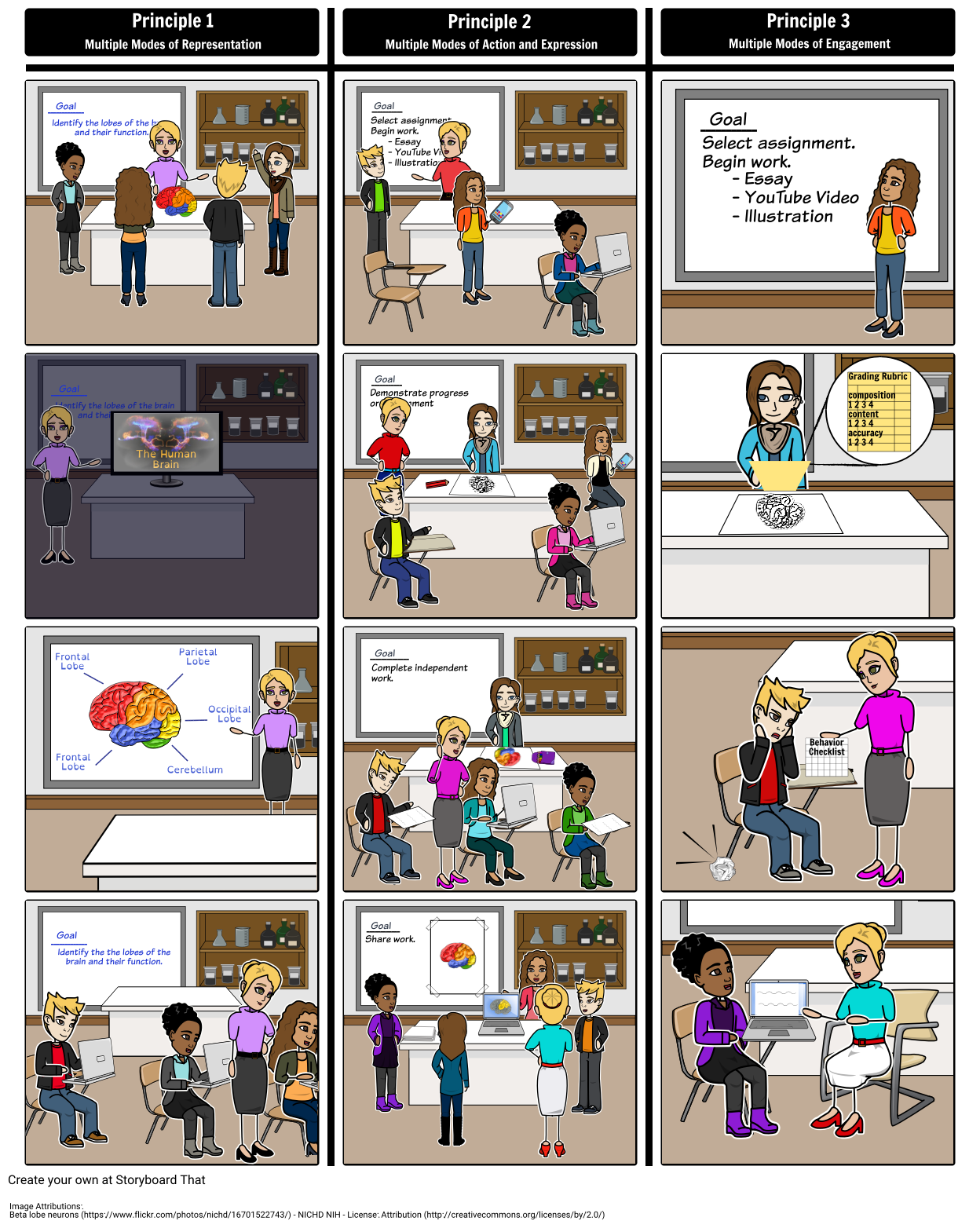
I am sure you have experienced the post-lunch afternoon slump that can destroy concentration. With the uptick in online learning requirements, now is the perfect time to familiarize yourself with how to make accessible courses that improve the learning experience for all participants. It’s important to teach to each student’s individual strengths, skills and needs. This is true for all kids — not just kids with learning and attention issues. While this helps adapt to students with disabilities such as autism, it’s good for all students to get used to classroom routines. This means structuring class time so that each student knows what they should be doing and when.
CAST created the Universal Design for Learning framework, and it remains one of our core levers of change to help make learning inclusive and transformative for everyone. CEUD is dedicated to enabling the design of environments that can be accessed, understood, and used regardless of a person's age, size, ability, or disability. Learners have different ways of perceiving and comprehending when presented with information. Sensory perception, learning disabilities, cultural and social differences all impact how content is perceived. By taking into account the social and medical needs of all users, it turns out it improves the experience for all. Universal Design for Learning (UDL) has developed around this same idea.
Tuition assistance is available for this program on a need and application basis. Tuition assistance is granted based on participant and institutional needs. Requests for tuition assistance do not affect an applicant's prospects for admission. You may access the tuition assistance application after you have submitted your program application.

No comments:
Post a Comment