Table Of Content

The Thinkific $1 Million Entrepreneur Growth Fund provides entrepreneurs funding, support and expertise needed to grow a business with online education. Lindsey Barlow, founder and CEO of Claire Lindsey Learning Inc., is a Thinkific Expert and Creative Learning Designer specializing in helping entrepreneurs and corporate clients pivot to online learning. Providing flexible content that doesn’t depend on one particular sensory input. Offering content in different modalities, so students have the autonomy to choose their preferred method. UDL is regarded so highly that it’s mentioned by name in the nation’s main education law.
UDL Principles for Course Communications
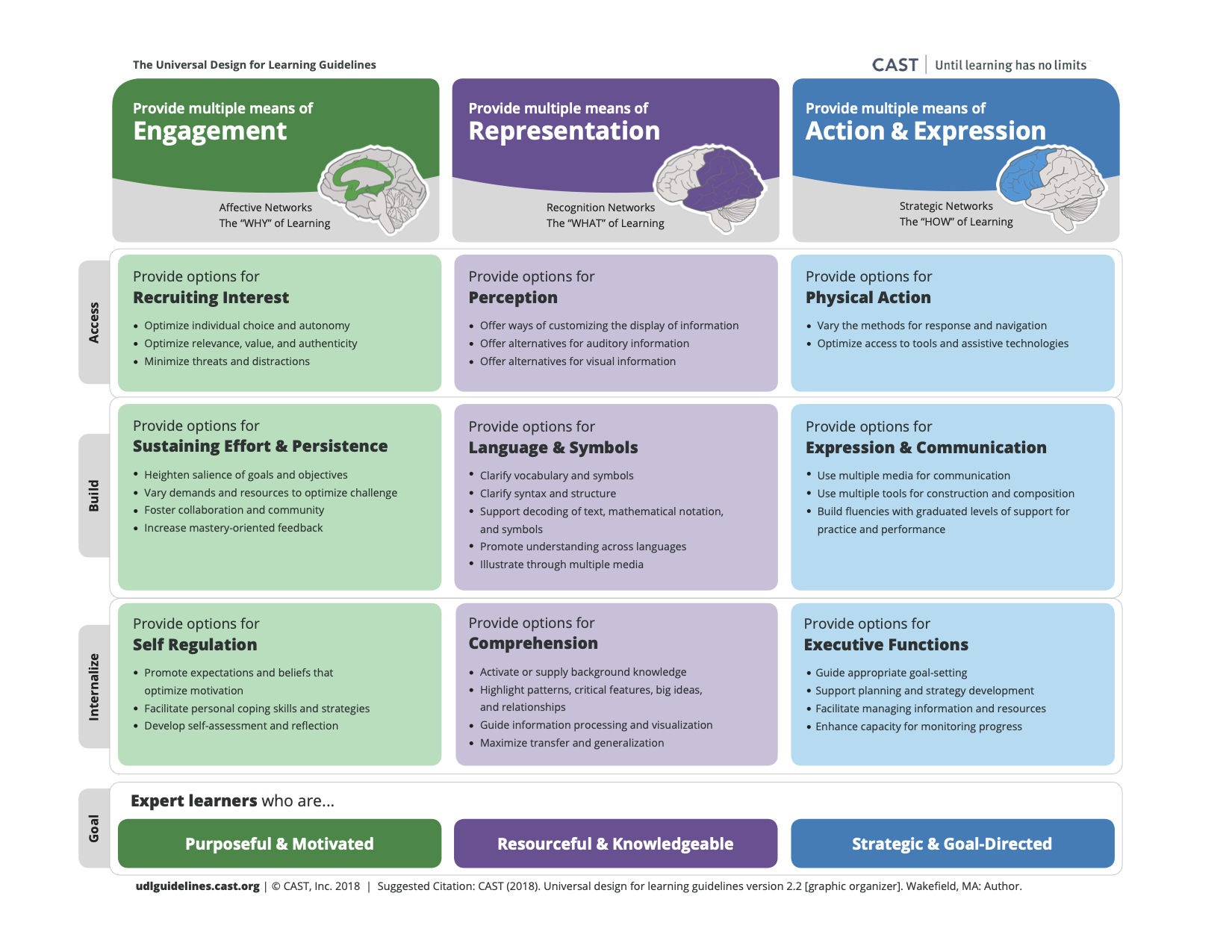
And finally, action and expression refers to providing students with means to engage in class based on those needs. This aspect of universal design for learning can be used in the classroom when teachers prompt students to highlight important phrases from their textbooks, or summarize the important aspects of a video lesson in one sentence. Helping students to feel safe in their learning environment is essential to a productive and motivated classroom.
Action and expression
In fact, a recent study found that 52% of course registrants never looked at the course. This could contribute to some who never complete your course and even add to your customer support requests. In fact, taking a look at the three principles of UDL and ways to use them could even boost your customer reviews and referrals, as all students will feel included and valued. Explain at back-to-school night or in a class email that you’ll be using Universal Design for Learning.
Universal Design for Learning: Strategies in the Classroom
The ultimate goal of UDL is for all learners to become “expert learners.” Expert learners are purposeful and motivated, resourceful and knowledgeable, and strategic and goal-directed about learning. Flexibility in the classroom also involves the physical space where students are learning. Try flexible seating by switching up the furniture arrangements to make students feel more comfortable (which, in turn, makes them more productive).
Universal Design for Learning Guidelines
UDL series — Engagement: Sustaining Effort & Persistence - Carleton College
UDL series — Engagement: Sustaining Effort & Persistence.
Posted: Thu, 14 Jul 2022 07:00:00 GMT [source]
Students will leave having had a positive experience and be ready to share how much they learned. Add them to your learning design process to improve accessibility and inclusion for all of your students. The goal of Universal Design for Learning is to remove barriers to learning.
Why Use UDL?
Leif E, Alfrey L and Grove C (2021).Practical, research-informed strategies to teach more inclusively (teachermagazine.com), accessed 26 April 2023. We welcome participants who have a basic understanding of UDL, are eager to deepen their UDL practice, and are motivated to develop into UDL leaders at their schools. This phase involves facilitating the lesson, observing, and getting feedback on how students are building the skills and habits. See more on UDL principles and how they can be applied, or use a course accessibility checklist to check how accessible your course is. Of course there’s more to great teaching, preparing our students for the future, and applying UDL than these four beliefs, but it’s only if we hold these beliefs that the other pieces then fall into place. The UDL Project seeks to provide the easiest way for communities to implement universal design in areas not regulated by the Americans with Disabilities Act (ADA).
The three UDL principles are engagement, representation, and action and expression. UDL is a powerful approach because from the very start of your lesson, it helps you anticipate and plan for all your learners. It can help you make sure that the greatest range of students can access and engage in learning — not just certain students. Other examples of UDL in the classroom include letting students complete an assignment by making a video or a comic strip. To get a deeper understanding of UDL, it also helps to see how it’s different from a traditional approach to education. Explore this chart that compares UDL and traditional education side by side (opens in a new window).
Basic principles of UDL
Group work can help students to reinforce skills by teaching others, it can also improve their collaborative and social-emotional learning skills too. This can still allow for flexibility in the order or time spent on subtasks, but helps students to know exactly where they are in the lesson. By the end of this article, you’ll be completely equipped to use UDL in your school, for the benefit of teachers and students' learning outcomes. Provide multiple means of action and expression for learners to demonstrate what they have learnt. For example, imagine a lesson in which your students read about the stages of butterfly metamorphosis and then draw a diagram of the process. This lesson has three main objectives — to have your students read, learn the stages of butterfly metamorphosis, and draw a scientific process.
The Importance of Universal Design for Learning Harvard Graduate School of Education - Harvard Graduate School of Education
The Importance of Universal Design for Learning Harvard Graduate School of Education.
Posted: Sat, 20 Dec 2008 08:00:00 GMT [source]
Engagement
You can even share a family-friendly article about the UDL approach to teaching. Design and deliver all course elements for maximum accessibility to give every student equitable opportunities for success. That way, each student gets to complete the assignment in the way that is best for them, while all students demonstrate a reasonable understanding of the topic. Ideally, students should also have some flexibility within these different formats.
Curriculum planning for every student in every classroom (AC00180) professional learning is available in MyPL. SFU students reflect a diverse, engaged, and global student body with a wide range of goals, both academic and beyond. In addition to your discipline’s teaching context, this diversity, has implications for how you design, plan, and implement your course in ways that will best fit the needs of all your students. Make sure that children in your classroom feel comfortable and safe bringing their whole selves—including their race, heritage, gender identity, and disabilities—into your classroom and address bias.
This article originally appeared on Understood.org (opens in a new window), a free online resource for parents of children with learning and attention issues. While grades are important in this discussion, they are not the only aspect of the student’s feedback. Teachers should also include goal planning and achievement when giving feedback. For example, a math teacher could help students see the relationship between addition and multiplication, prompting them to draw on past experience to help them learn new concepts. Teachers should also guide students to build relationships between information they’ve already learned and what they’re currently learning.
If you have ever hit a button with your elbow to automatically open a door to enter a building, while carrying two coffees, then you’ve experienced universal design. You don’t need specific tools or technologies to follow UDL’s principles either. Instead, your students choose from the tools and resources you already have.
When there are several students who share the same learning style or who have common interests, these can be grouped together for specific activities in the classroom. This helps students to avoid unnecessary frustration and continue learning effectively. This also includes helping students become self-motivated by guiding them through rubrics that allow for self-reflection and personal goals. The Ronald L. Mace Universal Design Institute (The Institute) is a non-profit organization based in North Carolina dedicated to promoting the concept and practice of accessible and universal design. Leave room in your content for students to have their own aha moments. Create activities that offer reflection and connection to their unique situation.
Lesson planning with Universal Design for Learning (UDL) can help you design your lessons to teach the range of students in your classrooms. This approach to teaching or to workplace training doesn’t specifically target people who learn and think differently. But it can be especially helpful for kids with these challenges — including those who have not been formally diagnosed. Find out how the UDL framework guides the design of instructional goals, assessments, methods, and materials that can be customized and adjusted to meet individual needs. Universal Design for learning is a set of principles that provide teachers with a structure to develop instructions to meet the diverse needs of all learners. Learners differ in the way they are able to navigate a learning environment and demonstrate their learning.
To analyze the goal, you need to identify the primary objective for this part of the lesson. Series from the EDUCAUSE Learning Initiative (ELI) provides concise information on emerging learning technologies. Each brief focuses on a single technology and describes what it is, where it is going, and why it matters to teaching and learning. Understood.org's programs for Families, Educators, and Young Adults focus on empowering people who learn and think differently and those who support them, offering customized, accessible resources and a compassionate community.
If you would like to explore applying UDL principles in your teaching, but you are not sure where to start, book a consultation with us, and we can help adapt these practices to your course and teaching context. This program welcomes registrations from both individuals and teams. First-time registrants need to create a Professional Education account to register. Watch this video to see what UDL looks like in a fifth-grade classroom.


No comments:
Post a Comment